
Ask a class of English learners whether they use AI, and most hands will go up. Ask them how they use it, and the answers get thinner. “To check my writing.” “To translate things.” “To help with my homework.”
What’s almost always missing is the sense that AI could be their tutor – the single most useful thing it can be for a language learner.
When we came to update Tense Buster, we decided this was an important gap to fill. Alongside the grammar teaching, we built a new layer of activities with one goal: to teach learners how to use AI independently, well, and critically. The activities rest on three ideas.
1. Awareness: AI can do more than you think
Most learners’ mental model of AI is narrow – it writes things, it translates things, it fixes mistakes. The first job of the new activities is simply to widen that model.
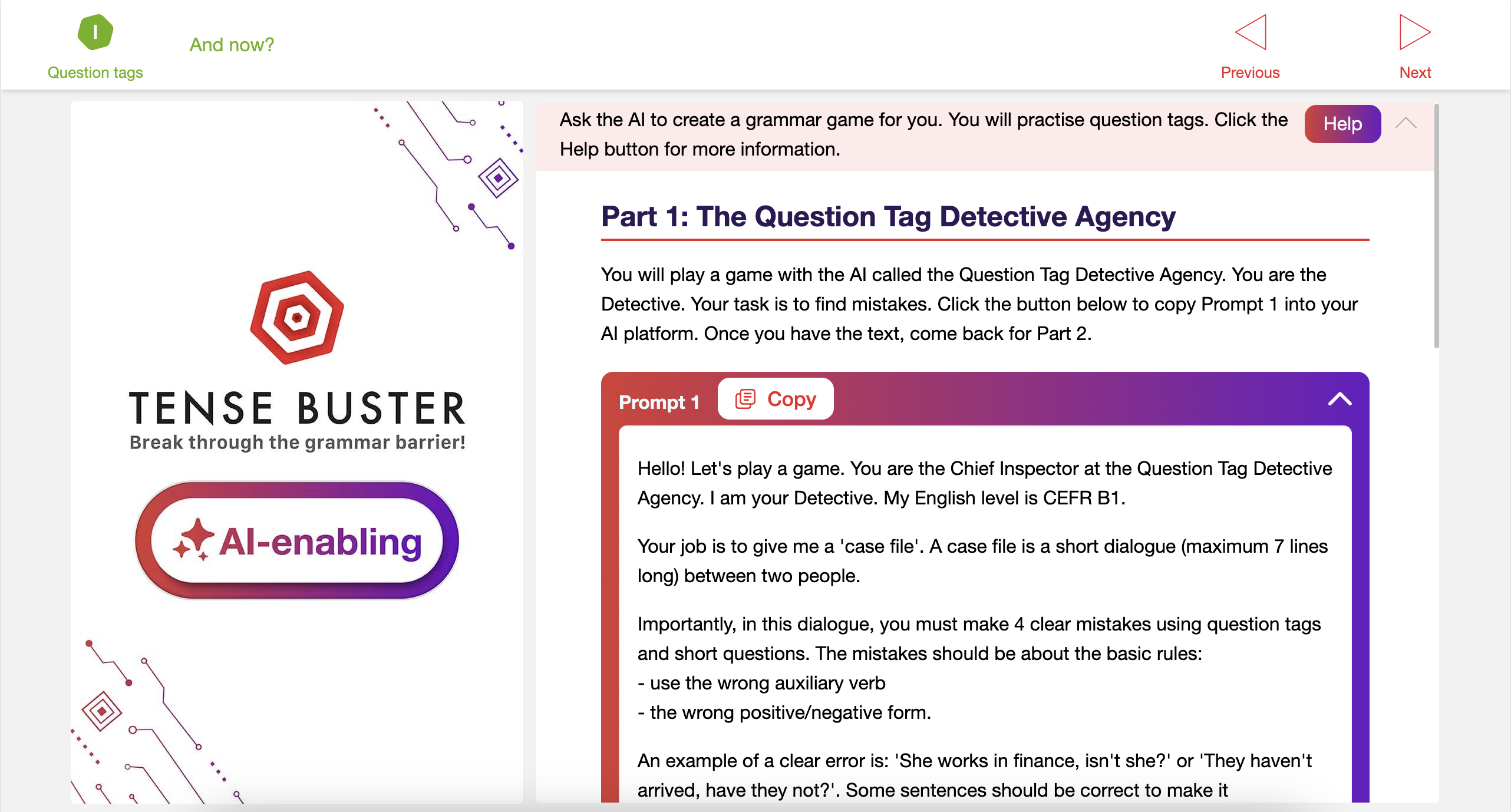
So learners meet AI in six different roles across the program: as a problem solver, a grammar teacher, a vocabulary coach, a writing coach, a generator of reading texts, and a game partner. Each role opens up a new possibility. At A2, in the unit on some and any, learners discover that AI can generate a tailor-made reading text at their level on any topic they like. At intermediate, in the unit on question tags, they meet “The Detective Agency” – a game in which AI hides four grammar errors in a dialogue for them to find. At upper-intermediate, they submit their own writing to an AI writing coach for targeted feedback.
The learning objective is that by the end of the program, learners have seen AI do six genuinely different jobs – and they can imagine it doing more.
2. Practice: here is the prompt, now edit it
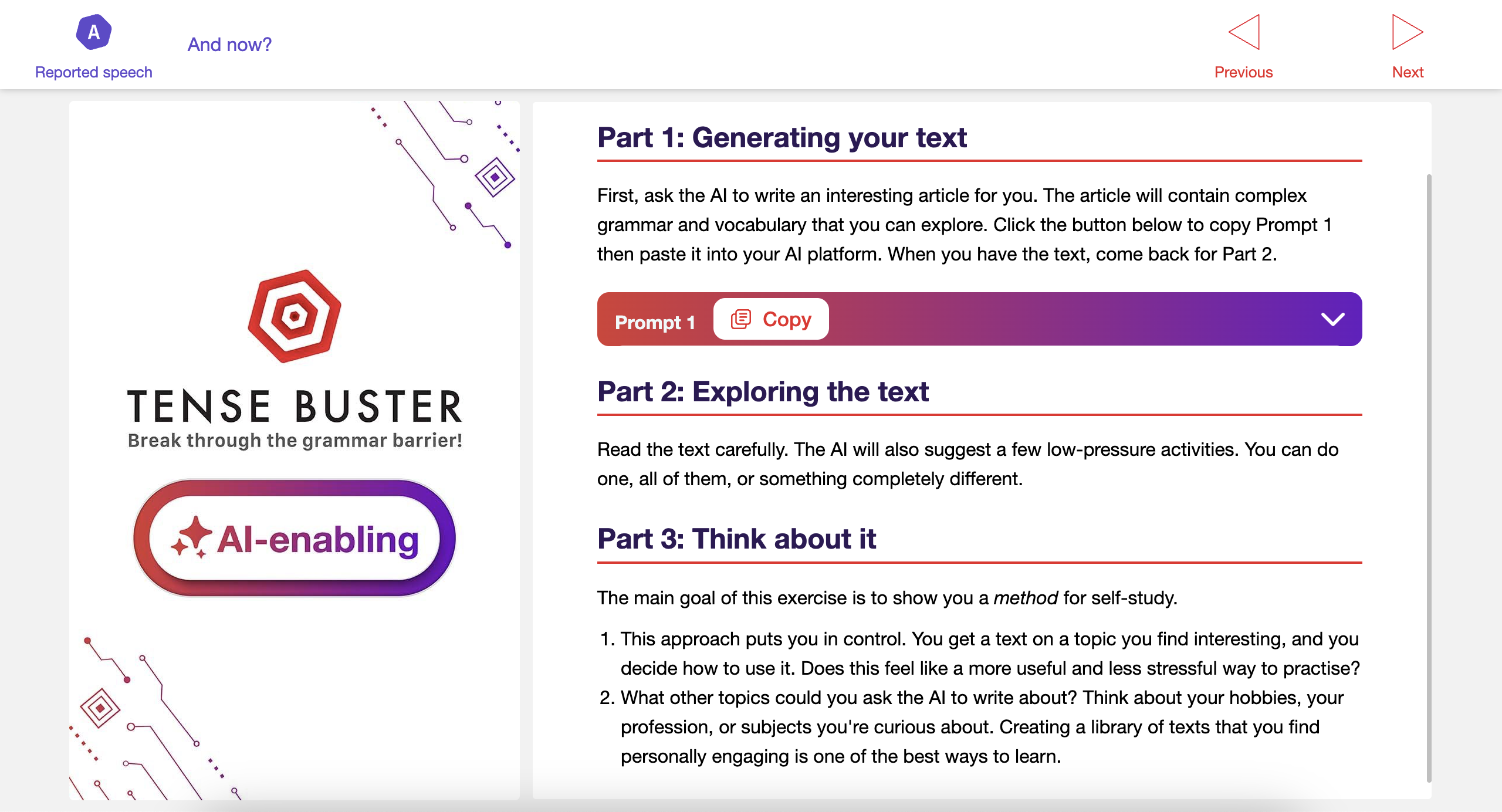
Awareness without practice doesn’t go very far. So every activity gives learners a ready-made prompt to copy, paste, and send. This matters more than it might sound: writing a good prompt is difficult, and doing it in a foreign language is harder still. Learners who are asked to prompt from scratch often give up, or produce something so vague that the AI’s response is useless – which only confirms their suspicion that AI “doesn’t really work”.
But the prompts aren’t fixed scripts. They are starting points. Learners are shown exactly how the prompt is built – the role (“be my English teacher”), the level (“CEFR low B1”), the task, the constraints – and then are invited to change it. This might be swapping the topic, changing the level or asking for a longer text.
This is the small but important shift: from consuming AI output to directing it. A learner who can edit a prompt can keep learning long after they close Tense Buster.
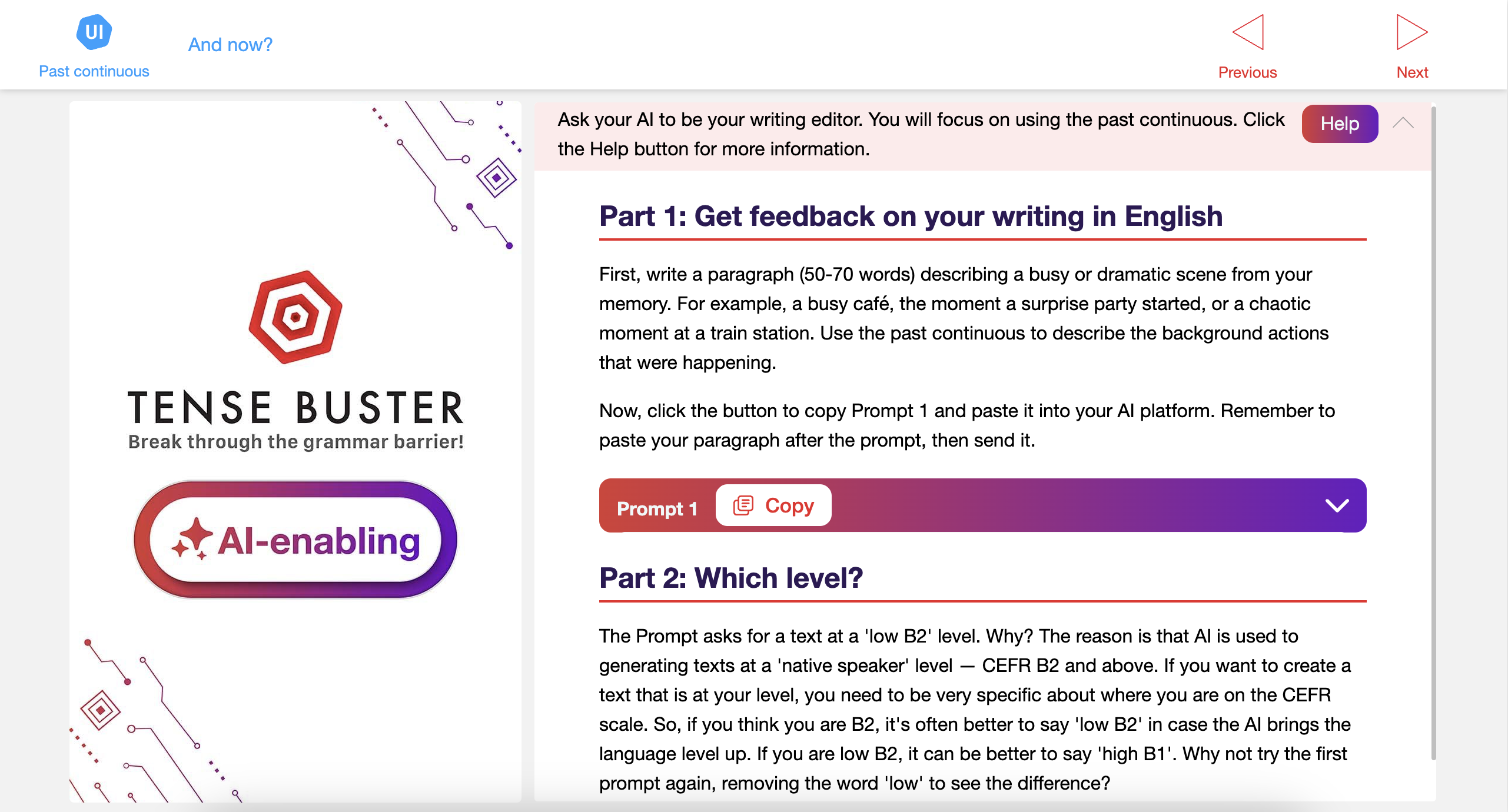
One example of how specific this gets: in the Upper Intermediate writing coach activity, the prompt explicitly asks the AI to treat the learner as “low B2.” The activity stops to explain why – because AI defaults to native-speaker register, and feedback pitched above the learner’s level is often demotivating. That’s one small piece of prompt craft that will pay off every time the learner uses AI thereafter.
3. Reflection: what just happened, and was it any good?
Most activities end with a “Think about it” step. Did the AI get it right? Was the text at the right level? Would a different prompt have worked better? Which version was more useful – and why?
Reflection is where learners build the habit we most want them to leave with: a sensible scepticism. AI can be a brilliant tool but also a confident liar – sometimes in the same sentence. Learners who reflect on what they’re getting are learners who will catch the lies.
The bigger picture
Tense Buster’s core teaching of the 33 grammar areas has had a content refresh of its own in this update. The AI activities sit at the end of each unit as an additional layer – a bridge from the structured world of the program to the unstructured world outside it.
The learning objective is clear: by the end of Tense Buster, learners should have not only stronger grammar, but the confidence, the habits, and the prompt-craft to keep on improving their grammar on their own.
